
Private label clothing has become a practical way for new brands, small businesses, and online sellers to launch products without investing in thousands of pieces at once. Instead of creating garments in huge quantities, businesses can work with manufacturers that accept smaller production orders.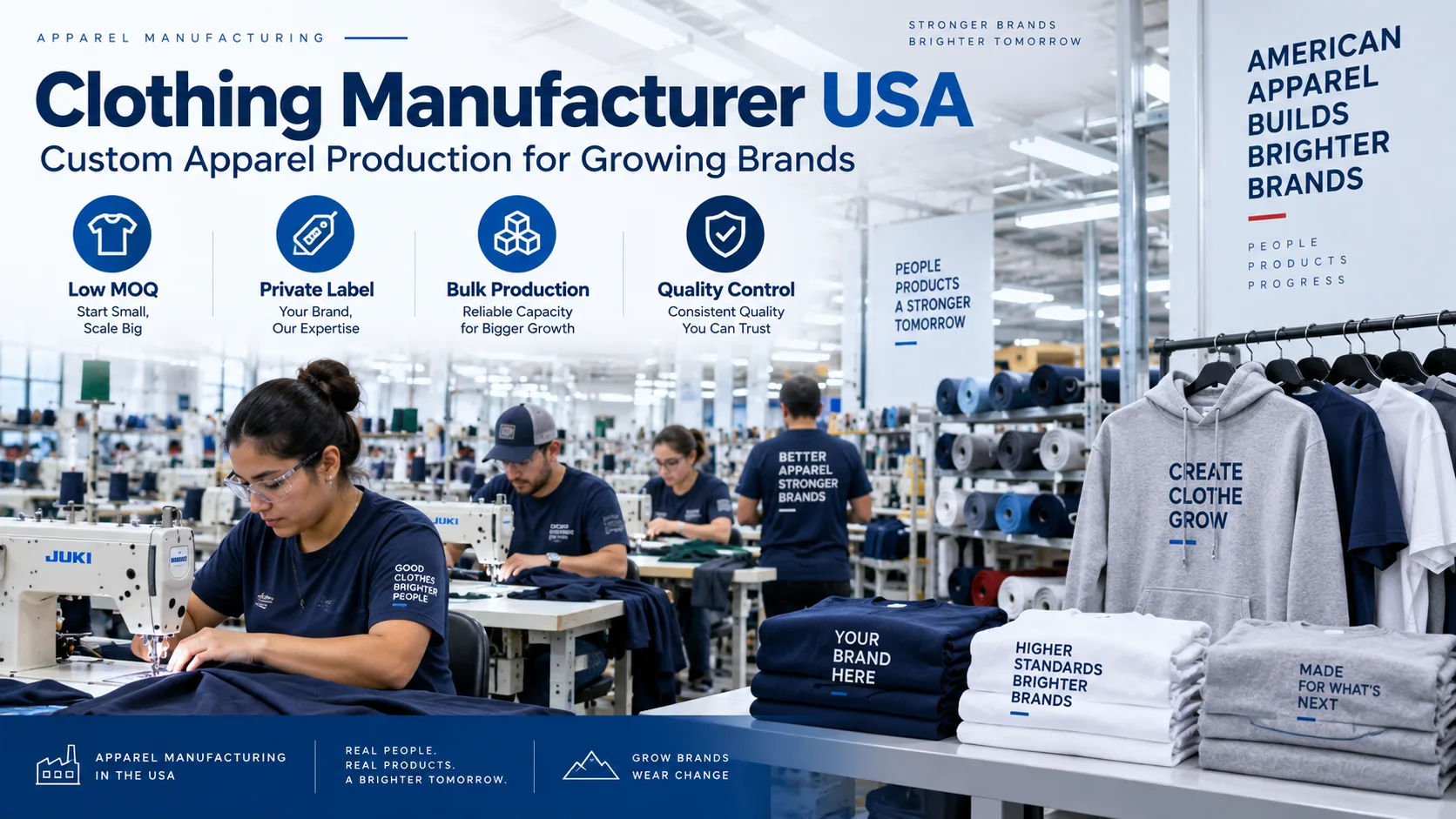
This approach is especially useful when a brand is testing a new product, entering a competitive market, or working with a limited budget. A small production run gives the business an opportunity to check quality, customer response, sizing, and sales before committing to larger quantities.
A low MOQ clothing manufacturer makes this possible by allowing brands to order a smaller number of customized garments while still providing private label services. The exact minimum quantity depends on the manufacturer, garment type, fabric, customization, and production process.
Understanding how this model works can help you avoid unexpected costs and choose a manufacturing partner that fits your business. From product development and sampling to labeling, production, quality control, and shipping, every stage matters.
What Is Low MOQ Private Label Manufacturing?
Low MOQ private label manufacturing is a production model where a clothing manufacturer allows a brand to produce customized garments in relatively small quantities.
MOQ means "Minimum Order Quantity." It refers to the smallest number of units a manufacturer is willing to produce for one order.
For example, a traditional manufacturer might require 500, 1,000, or even several thousand pieces of one design. A low MOQ supplier may accept orders starting from 20, 50, 100, or 200 pieces, depending on the product.
Private labeling means the manufacturer produces the garments for your brand rather than selling them under its own name. Your business can add its own labels, packaging, tags, branding, colors, designs, and other details.
This creates a middle ground between buying ready-made wholesale clothing and building a completely large-scale manufacturing operation.
How Does the Process Work?
The process usually follows several stages. While every manufacturer has its own system, the general workflow is fairly similar.
Step 1: Develop Your Clothing Idea
The process starts with your product concept.
You may already have a finished design, sketch, reference garment, technical drawing, or simply an idea of what you want to sell.
For example, you might want to create oversized hoodies, women's dresses, tracksuits, leather jackets, T-shirts, or children's clothing.
At this stage, you should decide important details such as fabric type, colors, sizing, fit, design features, branding, and intended price range.
The more information you provide, the easier it is for the manufacturer to understand what you want.
Step 2: Find a Suitable Manufacturer
The next step is finding a manufacturer that actually supports small production quantities.
Not every factory accepts low-volume orders. Some manufacturers focus entirely on large wholesale contracts because large production runs are more efficient for their machinery and workforce.
A low MOQ clothing manufacturer is generally more suitable for startups because its production system is designed to accommodate smaller orders.
However, do not choose a supplier based only on the lowest MOQ.
A manufacturer offering a 20-piece MOQ may charge much more per garment than one requiring 100 pieces. You need to compare the total production cost, quality, customization options, communication, and reliability.
Step 3: Discuss Your Requirements
Once you find a potential manufacturer, you normally provide your product specifications.
These may include:
-
Garment type
-
Fabric composition
-
Fabric weight
-
Colors
-
Size range
-
Measurements
-
Stitching requirements
-
Logo placement
-
Labels
-
Hangtags
-
Packaging
-
Embroidery
-
Screen printing
-
Special washes
-
Zippers, buttons, or other accessories
The manufacturer then evaluates whether the product can be produced within its facilities and gives you an estimated price.
This stage is important because small details can significantly affect the final cost.
Step 4: Request a Sample
A sample is one of the most important parts of private label manufacturing.
You should not assume that a manufacturer's production quality will automatically match your expectations.
A sample allows you to examine the fabric, construction, measurements, stitching, color, printing, embroidery, and overall appearance before placing the production order.
If something is wrong, you can request changes.
For example, you may discover that the sleeves are too long, the fabric is too thin, the neckline is too loose, or the logo is positioned incorrectly.
It is much cheaper to fix these problems during sampling than after hundreds of garments have already been produced.
Step 5: Approve the Sample
After reviewing the sample, you either approve it or request revisions.
Some manufacturers charge separately for samples, while others deduct the sample fee from your final production order.
Do not rush this stage.
If your final production is supposed to match the approved sample, keep detailed records of the specifications. Measurements, fabric details, color references, artwork, and branding instructions should be clearly documented.
Step 6: Confirm the Production Order
Once the sample is approved, you confirm the quantity you want to manufacture.
This is where the MOQ becomes important.
Suppose your supplier has a minimum order of 50 pieces per style. You may decide to produce 50 hoodies in one color or divide your order across different colors, depending on the supplier's rules.
Some manufacturers apply MOQ per design, while others apply it per color or fabric.
Always clarify this before paying.
Step 7: Pay the Required Deposit
Many clothing manufacturers require a deposit before starting production.
The exact payment structure varies between suppliers. A manufacturer might require a percentage upfront and the remaining balance before shipment.
Make sure you understand what the quoted price includes.
Ask whether the price covers labels, packaging, sampling, printing, embroidery, shipping preparation, and other services.
A low initial quotation can become expensive if many services are charged separately.
Step 8: Production Begins
After payment and final approval, production begins.
The factory purchases or prepares the required materials, cuts the fabric, prepares components, assembles garments, adds branding, and performs finishing work.
For a low MOQ clothing manufacturer, production planning can be different from mass manufacturing.
Smaller orders may be scheduled alongside other customers' orders. This can sometimes make production slower than expected, particularly during busy seasons.
That is why you should always ask for a realistic production timeline instead of assuming that a small order will automatically be completed quickly.
Why Do Businesses Choose Low MOQ Manufacturing?
The biggest advantage is lower financial risk.
A new brand may not know whether customers will actually buy a particular design. Ordering 1,000 pieces could leave the business with a large amount of unsold inventory.
A smaller order gives the brand a chance to test the market.
For example, you might launch 50 pieces of a new sweatshirt. If customers respond positively, you can place a larger repeat order.
This approach also allows businesses to experiment with different styles.
Instead of investing heavily in one design, you can test several products and identify which ones perform best.
Is Low MOQ More Expensive?
Usually, the per-unit cost is higher when the order quantity is smaller.
This happens because many manufacturing expenses do not decrease proportionally with order size.
The manufacturer may still need to prepare patterns, set up machines, purchase materials, create samples, prepare artwork, and organize production.
If these costs are spread across 50 garments instead of 1,000 garments, the cost per piece becomes higher.
However, higher unit pricing does not necessarily mean low MOQ manufacturing is a bad deal.
For a startup, avoiding thousands of dollars in unwanted inventory may be more valuable than getting the lowest possible unit price.
The real question is not simply "What is the cheapest garment?"
It is "What production quantity gives me the best balance between cost, risk, and demand?"
What Products Can Be Made With Low MOQ?
Many types of clothing can be produced through low MOQ manufacturing.
Common examples include T-shirts, hoodies, sweatshirts, tracksuits, leggings, dresses, shirts, jackets, uniforms, activewear, children's clothing, and fashion accessories.
However, the available options depend on the manufacturer's equipment and specialization.
Highly complicated garments may require larger quantities because they involve more production steps.
Simple garments are generally easier to produce in smaller runs.
For example, producing a basic cotton T-shirt may be easier at low volume than producing a heavily structured jacket with several specialized components.
What Customization Is Available?
Private label production can include much more than putting your logo on a shirt.
A low MOQ clothing manufacturer may offer custom fabric choices, colors, measurements, labels, hangtags, packaging, embroidery, printing, patches, zippers, buttons, and other design elements.
Some suppliers also provide cut-and-sew manufacturing.
This means you can provide your own design and have the manufacturer create the garment from the beginning rather than simply modifying an existing product.
The level of customization varies significantly between manufacturers.
Before choosing a supplier, ask for a clear list of what can be customized at your desired quantity.
What Are Private Labels?
Private labels are branding elements that identify the product as belonging to your business.
A clothing label might include your brand name, logo, size, fabric information, care instructions, or country of origin.
You may also use custom hangtags and branded packaging.
This helps turn a basic manufactured garment into a product that represents your own brand.
However, branding should not be treated as an afterthought.
Your label design, placement, material, and stitching quality all contribute to how customers perceive the product.
How Does Quality Control Work?
Quality control becomes especially important when ordering small quantities.
Before production, establish what acceptable quality means.
Check measurements against your approved specifications. Examine stitching, loose threads, fabric defects, color consistency, printing, embroidery, zippers, buttons, and labels.
For larger production runs, manufacturers may perform inspections during and after production.
For a smaller order, you can still request photographs or videos from the production floor if the supplier allows it.
If possible, arrange an independent inspection when the order value justifies the additional expense.
Do not rely entirely on attractive product photographs.
The actual finished garment is what your customer will receive.
What Should You Ask a Manufacturer Before Ordering?
Before working with a low MOQ clothing manufacturer, ask several practical questions.
First, ask for the exact MOQ and whether it applies per style, color, size, or total order.
Next, ask about sample costs and revisions.
Ask how long sampling takes and how long bulk production normally requires.
You should also ask about fabric sourcing, customization options, payment terms, quality control, packaging, shipping, and returns or defect policies.
It is also useful to ask whether the manufacturer has experience producing the type of garment you want.
A factory that specializes in basic T-shirts may not be the best choice for technical sportswear or structured outerwear.
What Hidden Costs Should You Watch For?
Low MOQ does not always mean low total cost.
Potential additional expenses include sample fees, pattern development, fabric sourcing, custom labels, hangtags, printing, embroidery, packaging, molds, special trims, shipping, customs, taxes, and revisions.
Shipping can be particularly important for international brands.
A manufacturer may quote an attractive garment price, but the final landed cost can be significantly higher after freight and import charges.
Calculate the complete cost before deciding whether an order is profitable.
How Can You Reduce Low MOQ Costs?
One of the easiest ways to control costs is to keep your first design relatively simple.
Too many colors, trims, custom components, or complicated construction can increase production expenses.
Using standard fabrics that the manufacturer already keeps in stock may also reduce sourcing problems.
You can also negotiate repeat-order terms.
If your first small order performs well, tell the manufacturer that you intend to increase the quantity in future production runs.
Manufacturers may be more willing to offer better pricing when they see the potential for long-term business.
Low MOQ vs Traditional Large-Scale Manufacturing
Traditional manufacturing is often better suited to established brands with predictable demand.
Large orders generally provide lower unit costs and can improve production efficiency.
Low MOQ manufacturing is better suited to startups, independent designers, small online stores, influencers, boutique brands, and businesses testing new products.
The trade-off is simple.
Large-scale manufacturing can provide better pricing but creates greater inventory risk.
Low MOQ manufacturing usually costs more per item but reduces the amount of money tied up in stock.
For a new brand, that flexibility can be extremely valuable.
Common Mistakes to Avoid
One common mistake is choosing a supplier only because it has the lowest MOQ.
Another is skipping the sample stage.
Some businesses also fail to calculate shipping and other additional expenses before setting their retail prices.
Poor communication is another major problem.
If your manufacturer does not clearly understand your measurements, fabric requirements, or branding instructions, mistakes can happen.
Always keep written records of approved specifications.
Do not depend entirely on verbal conversations.
Another mistake is ordering too many different products during the first launch.
Testing several products can be useful, but spreading a small budget across too many designs may make inventory management difficult.
Start with a focused collection and learn from the results.
How to Choose the Right Manufacturer
Look for a manufacturer with experience in your product category and a production system suitable for your order size.
Ask for samples and evaluate them carefully.
Check how quickly and clearly the supplier communicates.
A manufacturer that takes days to answer simple questions may become difficult to work with when you have an urgent production issue.
You should also examine reviews, references, previous work, and available production capabilities.
A professional low MOQ clothing manufacturer should be able to explain its MOQ rules, production timeline, customization options, pricing structure, and quality control process without making everything unnecessarily complicated.
Transparency is a good sign.
Is Low MOQ Manufacturing Good for New Clothing Brands?
For many new brands, yes.
The biggest advantage is flexibility.
You can start with a smaller investment, test your designs, collect customer feedback, and use actual sales data to decide what to manufacture next.
This reduces the risk of filling your storage space with products that nobody wants.
However, low MOQ manufacturing is not automatically profitable.
Your success still depends on product quality, pricing, branding, marketing, customer service, and demand.
Manufacturing is only one part of building a clothing business.
Conclusion
Low MOQ private label manufacturing gives smaller brands a practical way to enter the clothing market without immediately committing to huge production quantities.
The basic process is straightforward. You develop a product idea, find a suitable manufacturer, discuss your specifications, order a sample, approve the sample, confirm your production quantity, pay the required deposit, and move into production.
Working with a low MOQ clothing manufacturer can reduce inventory risk and make it easier to test new products. Instead of spending heavily on thousands of garments, you can begin with a smaller collection and increase production after you understand what customers actually want.
The most important thing is to look beyond the MOQ itself. A supplier offering a very small minimum order is not necessarily the best supplier. Quality, communication, customization, production reliability, pricing, shipping, and transparency all matter.
Always request a sample before committing to production. Confirm exactly what your quoted price includes. Understand whether MOQ applies per style, color, or total order. Calculate your complete landed cost, including shipping and other charges.
For a startup, the goal should not simply be to find the smallest possible order. The goal should be to find a production quantity that lets you test your market without taking unnecessary financial risks.
When approached carefully, low MOQ private label manufacturing can give a new clothing brand the flexibility to experiment, improve products, build a customer base, and gradually move toward larger and more efficient production runs.