
Pinterest Automation can be a powerful way to increase website visitors when it is used strategically. Unlike many social platforms where content has a short lifespan, Pinterest works more like a visual search engine. Users often visit the platform to discover ideas, find solutions, research products, and save content they may want to explore later. 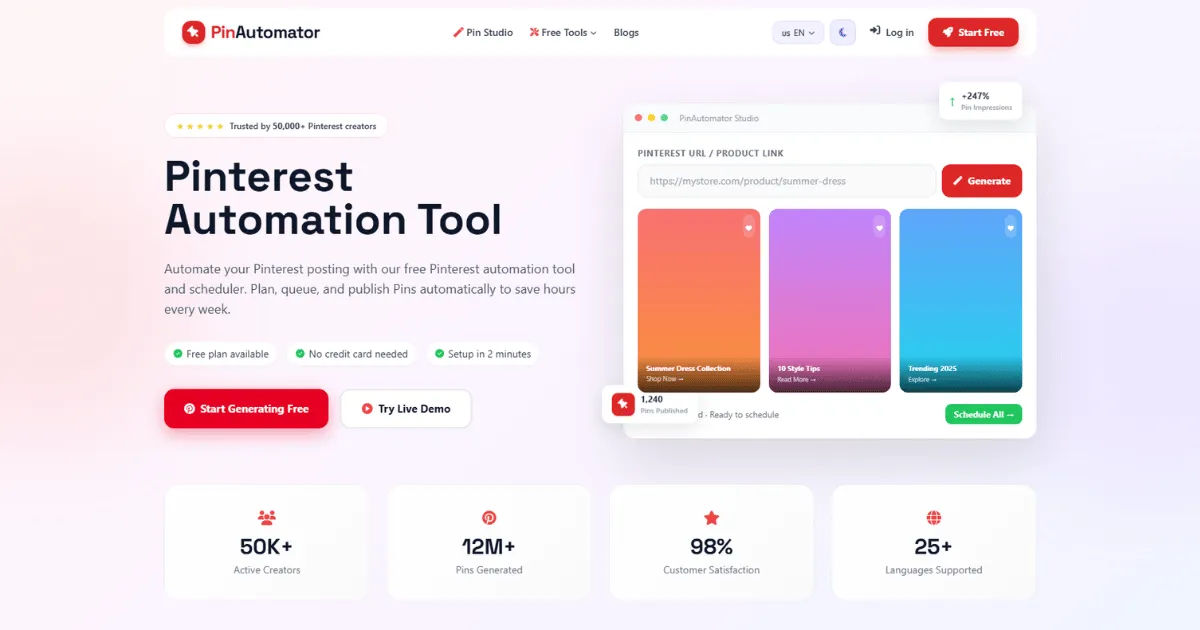
However, simply automating Pinterest activity does not automatically guarantee more traffic. The results depend on the quality of the content, the relevance of the pins, the strength of the website, keyword targeting, consistency, and the overall strategy behind the automation process.
When implemented correctly, Pinterest Automation can reduce repetitive work while helping businesses maintain a consistent publishing schedule. It can support content distribution, improve visibility, and make it easier to send Pinterest users toward useful pages on a website.
The real question is whether automation itself drives more visitors or whether it simply makes an effective Pinterest strategy easier to manage. The answer is that automation can contribute significantly to website traffic, but it works best as part of a complete content and marketing strategy.
How Pinterest Drives Website Traffic
Pinterest is different from many traditional social media platforms. While platforms such as Instagram and TikTok often focus heavily on real-time engagement and entertainment, Pinterest is strongly connected to discovery and search behavior.
People use Pinterest to find recipes, home designs, fashion inspiration, travel ideas, business advice, tutorials, products, and many other types of information. When a user finds an attractive pin, they may click it to learn more.
That click can take the user directly to a website.
For this reason, Pinterest can function as a traffic generation channel rather than simply a platform for social interaction. A well-designed pin can introduce someone to a blog post, product page, landing page, service page, or other online resource.
The relationship is relatively simple. A business publishes useful content on its website, creates a Pinterest pin related to that content, and connects the pin to the appropriate webpage. Pinterest users discover the pin through search, recommendations, or their feeds. Interested users then click through to the website.
This process can happen repeatedly over time.
A successful pin may continue generating clicks weeks or months after it was originally published. This long-term potential is one of the reasons Pinterest can be valuable for businesses that want sustainable website traffic.
Automation can make this process easier by reducing the amount of manual work required to publish and manage content consistently.
What Pinterest Automation Actually Means
Pinterest Automation refers to using tools, systems, or workflows to simplify repetitive Pinterest marketing tasks.
Depending on the tools being used, automation may help with scheduling pins, organizing content, managing publishing calendars, tracking performance, and maintaining a consistent posting routine.
The goal is not necessarily to remove humans from the process. Instead, the goal is to reduce repetitive tasks so marketers can spend more time on strategy and creative work.
For example, a blogger may publish several articles each month. Each article may need multiple Pinterest graphics. Instead of manually publishing every pin at different times, the blogger can prepare the content in advance and schedule it.
This creates a more organized workflow.
Automation can also help businesses distribute content consistently. Rather than publishing randomly whenever someone remembers to update Pinterest, a structured schedule can keep the account active.
However, automation should not be confused with low-quality mass posting. Publishing hundreds of irrelevant or repetitive pins will not necessarily increase website traffic. In some situations, it can reduce content quality and make the account less appealing.
Effective automation is about efficiency and consistency.
Why Website Traffic Matters for Businesses
Website traffic is important because it creates opportunities that social media engagement alone cannot always provide.
When people visit a website, they can read an article, subscribe to an email list, purchase a product, request a quote, book a service, or explore other pages.
A Pinterest user who clicks through to a website has already shown some level of interest. The person did not simply scroll past the content. They took an additional action.
This makes website visits valuable.
For ecommerce businesses, Pinterest traffic can lead to product discovery and purchases. For bloggers, it can increase page views and advertising opportunities. For service businesses, it can introduce potential customers to their services.
The quality of traffic matters as much as the quantity.
A website that receives 10,000 visitors who have no interest in its products may generate fewer results than a website receiving 1,000 highly relevant visitors.
A good Pinterest strategy therefore focuses on attracting the right audience rather than simply increasing visitor numbers.
How Pinterest Automation Can Increase Website Visitors
Pinterest Automation can support website traffic growth in several important ways.
The first is consistency.
Consistency is one of the biggest challenges in digital marketing. A business may have excellent content but fail to promote it regularly because the team is busy with other responsibilities.
Automation helps solve this problem.
Content can be prepared ahead of time and scheduled for publication. This allows businesses to maintain a predictable publishing rhythm without requiring someone to manually post every day.
Over time, consistent visibility can create more opportunities for users to discover website content.
Another advantage is scalability.
A small business may initially manage Pinterest manually without much difficulty. As the content library grows, however, the workload can become difficult to manage.
Automation allows marketers to handle a larger volume of content without increasing manual effort at the same rate.
For example, a website with 200 useful blog posts may have hundreds of opportunities to create Pinterest content. A structured automation workflow can help organize and distribute that content over time.
This can increase the number of potential entry points between Pinterest and the website.
Consistency Creates More Traffic Opportunities
One of the strongest benefits of Pinterest Automation is the ability to maintain consistency.
Imagine two businesses with equally useful websites.
The first business publishes pins occasionally. It may post several pins one week and then remain inactive for a month.
The second business uses a structured schedule. It consistently publishes relevant content throughout the month.
The second business has more opportunities to appear in front of users.
This does not mean that posting more always guarantees better results. Quality still matters. However, consistent publishing can increase the number of opportunities for Pinterest users to discover a brand.
Over time, a consistent presence can also help businesses identify which topics perform well.
For example, a business may discover that pins about beginner tutorials receive more clicks than general promotional content. This information can influence future content creation.
Automation makes it easier to maintain the publishing schedule required to test these ideas.
Automation Helps Repurpose Existing Content
Creating new content constantly can be expensive and time-consuming.
Many businesses already have valuable content that is not receiving enough attention. Old blog posts, guides, tutorials, product pages, and resources can often be promoted again through Pinterest.
A single article may be represented by several different pin designs.
Each design can highlight a different benefit, question, statistic, or solution from the same article.
For example, an article about improving home organization could inspire pins focused on storage ideas, decluttering tips, small-space solutions, and organizational mistakes.
All of these pins may lead to the same article.
This approach creates multiple opportunities for discovery without requiring the business to create an entirely new article for every pin.
Automation can help schedule these variations over time.
The result is a more efficient content distribution system.
The Importance of Pinterest SEO
Pinterest is heavily influenced by search and discovery. This means optimization plays an important role in attracting visitors.
Pinterest SEO involves using relevant keywords in appropriate areas of a Pinterest profile and content.
Keywords can help Pinterest understand what a pin is about and connect it with relevant searches.
For example, a business selling home decor products might target phrases related to living room design, bedroom decor, minimalist interiors, or small apartment ideas.
The exact keywords should reflect what the target audience is actually searching for.
Automation does not replace keyword research.
A scheduling tool can publish content at the right time, but it cannot automatically guarantee that the content is optimized for the right audience.
Businesses should therefore conduct keyword research before building automated publishing workflows.
Relevant keywords can be incorporated naturally into pin titles and descriptions as well as related boards and website content.
Why Pin Quality Affects Website Traffic
Automation can increase publishing efficiency, but the quality of each pin still matters.
Pinterest is a visual platform, so the design of a pin can influence whether someone stops scrolling and decides to learn more.
Effective pins usually communicate a clear idea quickly.
The design should be easy to understand. Text should be readable, imagery should support the topic, and the overall presentation should match the brand.
A confusing or unattractive pin may receive fewer clicks even if it links to an excellent article.
This is why businesses should invest time in creating strong visual content before automating distribution.
Automation should distribute good content.
It should not be used to distribute weak content faster.
Creating Multiple Pins for One Website Page
One effective strategy is to create several unique pins for a single webpage.
This can be useful because different users respond to different visual styles and messages.
One pin might focus on a question.
Another might highlight a benefit.
A third might use a list-based headline.
A fourth could emphasize a specific problem that the webpage solves.
All of these pins can direct visitors to the same destination.
The important point is that the designs and messaging should be genuinely useful and distinct rather than simple duplicates.
Pinterest Automation can then help distribute these variations according to a planned schedule.
This approach increases the number of opportunities for a webpage to appear in front of relevant users.
How Automation Supports Content Marketing
Content marketing and Pinterest can work together effectively.
Suppose a company publishes educational blog posts about its industry. Each article represents an opportunity to attract visitors through search engines, social platforms, and other channels.
Pinterest can become an additional distribution channel.
Automation helps ensure that new articles are promoted consistently instead of being forgotten shortly after publication.
A company can create a content calendar that connects blog publishing with Pinterest promotion.
When a new article goes live, several Pinterest graphics can be prepared. These graphics can then be scheduled across an appropriate period.
This gives the content a longer promotional life.
Instead of receiving attention only on the day it is published, the article may continue attracting visitors through Pinterest discovery.
The Role of Evergreen Content
Evergreen content is particularly valuable for Pinterest traffic.
Evergreen content remains useful for a long period. Examples include tutorials, guides, checklists, recipes, educational articles, and problem-solving resources.
Because these topics remain relevant, they can continue attracting Pinterest users over time.
This makes them suitable for scheduled promotion.
For example, an article explaining how to organize a small kitchen may remain relevant for years. A pin linked to that article can continue to attract attention as users search for organization ideas.
Pinterest Automation can help keep evergreen content in circulation.
The key is to maintain relevance and avoid excessive repetition.
Businesses should monitor performance and refresh old content when necessary.
Automation and Ecommerce Website Traffic
Ecommerce businesses can also benefit from Pinterest traffic.
Pinterest users often search for inspiration before making purchasing decisions. They may look for clothing ideas, furniture designs, gift suggestions, beauty products, recipes, or home improvement inspiration.
This makes Pinterest useful for product discovery.
A business can create visually appealing pins that lead directly to product pages or related collections.
Automation can help distribute product-focused content consistently.
However, ecommerce businesses should avoid making every pin feel like a direct advertisement.
Educational and inspirational content can be equally important.
For example, a furniture store might publish pins about bedroom design ideas rather than simply posting product images. The content can then introduce users to products that fit the design.
This approach can make the promotional experience more natural.
Pinterest Automation for Bloggers
Bloggers are among the users who can benefit significantly from automated Pinterest workflows.
A blog may contain dozens or hundreds of articles. Each article represents a potential traffic source.
Manually promoting every article can become difficult.
Automation allows bloggers to build a content distribution system.
For example, a blogger can prepare multiple graphics for each article and organize them in a publishing calendar.
Older articles can be included alongside newer content.
This helps prevent the common problem of creating excellent content but failing to promote it consistently.
For bloggers, website traffic can lead to advertising revenue, affiliate commissions, email subscribers, digital product sales, or sponsorship opportunities.
Pinterest can therefore become an important part of the overall traffic strategy.
Does More Pinning Always Mean More Visitors?
Not necessarily.
Publishing more pins does not automatically guarantee more website visitors.
The relationship between volume and traffic is more complicated.
A large number of poorly designed or irrelevant pins may produce very little traffic.
On the other hand, a smaller number of highly relevant and well-designed pins can perform much better.
The objective should be to find a sustainable balance between quantity and quality.
Businesses should test different publishing frequencies and monitor the results.
If increasing the number of pins produces more impressions but no increase in clicks, the problem may be with the content, messaging, design, or audience targeting.
Analytics should guide decisions.
Automation should support experimentation rather than encourage blind publishing.
Measuring the Success of Pinterest Traffic
To determine whether Pinterest is actually driving more visitors, businesses need to track performance.
Important metrics may include impressions, saves, outbound clicks, click-through rate, website sessions, conversions, and revenue.
Impressions indicate how often content is shown.
Outbound clicks are especially important when the goal is website traffic.
A pin may receive thousands of impressions but generate very few clicks. This could indicate that the design attracts attention but does not create enough curiosity to encourage users to visit the website.
Website analytics provide another layer of information.
Businesses can examine how Pinterest visitors behave after arriving on the website.
Do they stay and read?
Do they visit multiple pages?
Do they sign up for an email list?
Do they make purchases?
These questions help determine whether Pinterest traffic is valuable.
Improving Click-Through Rates
If the goal is to drive more website visitors, click-through rate deserves special attention.
A strong click-through rate often depends on the relationship between the visual, headline, and landing page.
The pin should create enough interest to encourage a click while accurately representing what the user will find after clicking.
Misleading headlines may generate short-term clicks but can damage trust.
Clear and specific messaging is usually more effective.
For example, instead of using a vague phrase such as "Amazing Ideas," a pin might say "10 Simple Ways to Organize a Small Bedroom."
The second option gives users a clearer reason to click.
Automation can help distribute different headline variations so marketers can compare results.
The Importance of Landing Page Quality
Getting visitors from Pinterest is only part of the process.
The website itself must provide a good experience.
If users click a pin and arrive at a slow, confusing, or irrelevant webpage, they may leave immediately.
This can reduce the value of Pinterest traffic.
The landing page should match the promise made by the pin.
If the pin promotes a guide, the user should immediately find that guide.
If the pin promotes a product, the product page should be easy to navigate.
Mobile responsiveness is also important because many Pinterest users access the platform through mobile devices.
A fast and user-friendly website can help convert Pinterest visitors into engaged readers, subscribers, leads, or customers.
Common Mistakes in Pinterest Automation
One common mistake is relying entirely on automation.
Automation is a tool, not a complete strategy.
Businesses still need to understand their audience, create useful content, monitor trends, analyze results, and adjust their approach.
Another mistake is publishing repetitive content.
If every pin looks identical, users may lose interest.
A third mistake is ignoring Pinterest SEO.
Without relevant keywords, even attractive content may struggle to reach the right audience.
Another problem is focusing only on quantity.
Publishing hundreds of low-quality pins may not generate meaningful traffic.
Businesses should also avoid sending every visitor to a generic homepage.
Specific pins should ideally lead to specific, relevant pages.
The closer the relationship between the pin and landing page, the more useful the visitor experience is likely to be.
How to Build an Effective Automated Pinterest Strategy
A strong strategy begins with clear goals.
A business should decide whether it wants to increase blog traffic, generate leads, sell products, grow an email list, or improve brand visibility.
The goal influences the type of content that should be created.
The next step is identifying the target audience.
Understanding what users want to learn, solve, buy, or discover makes it easier to create relevant content.
Keyword research should follow.
Once important search terms are identified, businesses can develop content around those topics.
Then comes the visual content process.
Each important webpage should have attractive Pinterest graphics designed for the platform.
After that, content can be organized into a publishing calendar.
Automation tools can help schedule the content according to the chosen strategy.
Finally, performance should be reviewed regularly.
This process creates a cycle of publishing, measuring, learning, and improving.
How Often Should Businesses Use Pinterest Automation?
There is no universal publishing frequency that works for every account.
The ideal schedule depends on the size of the content library, the available resources, the audience, and the type of business.
A small blog may start with a manageable schedule and gradually increase publishing as it creates more content.
A larger brand may have enough content to maintain a more active schedule.
The important factor is sustainability.
A business should choose a schedule it can maintain consistently.
It is better to publish high-quality content regularly than to publish aggressively for a short period and then stop.
Automation makes consistency easier, but the underlying strategy should remain flexible.
Pinterest Automation and Long-Term Traffic Growth
One of the biggest advantages of Pinterest is its potential for long-term discovery.
Some social media posts have a very short period of visibility.
Pinterest content can behave differently.
A useful pin may continue appearing in search results and recommendations long after publication.
This creates the possibility of cumulative traffic growth.
For example, imagine a website publishes 50 useful articles in one year. Each article is supported by several Pinterest graphics.
Over time, the website may build a large collection of content that can be discovered through Pinterest.
The traffic potential comes from the combined effect of many pieces of content.
Automation helps manage this growing library.
As the content collection expands, a structured system becomes increasingly valuable.
Can Pinterest Automation Replace Manual Marketing?
It should not.
The best approach is usually a combination of automation and human decision-making.
Automation is excellent for repetitive tasks such as scheduling and organizing.
Humans are better at understanding context, creating original ideas, evaluating audience behavior, responding to trends, and making strategic decisions.
A completely automated approach may become repetitive or disconnected from audience needs.
A human-led strategy supported by automation is more likely to remain flexible.
Businesses should therefore treat automation as an assistant rather than a replacement for marketing strategy.
Who Can Benefit Most From Pinterest Automation?
Pinterest Automation can be useful for many types of businesses and creators.
Bloggers can use it to distribute articles.
Ecommerce brands can promote products and collections.
Service businesses can share educational content and attract potential clients.
Coaches and consultants can promote guides and resources.
Travel websites can share destination content.
Home and lifestyle brands can showcase inspiration.
Food bloggers can promote recipes.
The strongest results usually occur when the audience naturally uses Pinterest to discover ideas related to the business.
Not every industry will receive the same level of benefit.
The best approach is to evaluate whether the target audience is active on the platform and whether the business has visually appealing or educational content to share.
How AI Can Improve Pinterest Automation
Artificial intelligence can make automated Pinterest workflows more efficient.
AI tools can assist with brainstorming content ideas, generating headline variations, identifying topics, organizing content, and analyzing performance patterns.
For example, a marketer might use AI to create several possible pin titles for an article.
The marketer can then select and refine the strongest options.
AI can also help identify content gaps.
If a website has many articles about advanced topics but very little beginner-friendly content, AI-assisted analysis may help identify opportunities for new content.
However, AI-generated content should always be reviewed by humans.
Accuracy, originality, brand voice, and relevance remain important.
Technology can speed up the workflow, but human judgment still determines whether the content is genuinely useful.
The Difference Between Automation and Spam
This distinction is extremely important.
Automation is about improving efficiency.
Spam is about producing excessive, low-value content with little regard for the user experience.
A responsible automated strategy focuses on useful content, relevant keywords, attractive visuals, and appropriate publishing frequency.
The goal should be to help users discover valuable resources.
Businesses should always follow Pinterest's current policies and avoid manipulative practices.
The long-term objective is to build trust and attract genuinely interested visitors.
How to Improve Results Over Time
Pinterest traffic growth usually requires ongoing experimentation.
Businesses should test different visual designs, headlines, content topics, and calls to action.
Performance data can reveal what works.
For example, one type of pin may generate many impressions but few clicks. Another may receive fewer impressions but produce significantly more website visits.
The second type may be more valuable.
Businesses should also identify their highest-performing content.
If certain topics consistently generate traffic, more content can be created around those subjects.
Underperforming content can be redesigned, rewritten, or replaced.
This continuous improvement process makes automation more effective over time.
The Role of Patience in Pinterest Traffic Growth
Pinterest traffic may not increase dramatically overnight.
Building a strong presence often requires time.
New accounts may need time to establish content libraries, identify effective keywords, and understand audience behavior.
Businesses should avoid judging the entire strategy based on a few days or weeks of data.
Longer-term measurement can provide a more accurate picture.
The most successful approach is usually consistent and patient.
A business that publishes useful content, optimizes it properly, monitors performance, and improves its strategy over time is more likely to build sustainable traffic.
Is Pinterest Automation Worth Using?
For many businesses, the answer can be yes.
The greatest value comes from saving time while maintaining consistent content distribution.
If a business already has useful website content and an audience interested in visual discovery, automation can make Pinterest marketing more manageable.
However, businesses should not expect automation alone to solve traffic problems.
If the website has weak content, poor design, irrelevant topics, or an unclear audience, automation will not automatically fix those issues.
The foundation must come first.
A strong website, useful content, relevant keywords, quality visuals, and a clear audience strategy provide the foundation. Automation then helps distribute and manage that content more efficiently.
How to Know Whether Pinterest Automation Is Working
The simplest way to evaluate success is to compare Pinterest activity with website results.
Look at traffic before and after implementing a structured strategy.
Monitor outbound clicks and website sessions from Pinterest.
Then examine what visitors do after arriving.
If traffic increases but conversions remain low, the problem may not be Pinterest itself. The website or offer may need improvement.
If impressions increase but clicks remain low, the pin design or messaging may need adjustment.
If clicks increase but visitors leave quickly, the landing page may not match user expectations.
This kind of analysis allows businesses to identify exactly where improvements are needed.
Conclusion
Pinterest Automation can drive more website visitors, but its effectiveness depends on how it is implemented. Automation does not create traffic by itself. Instead, it makes it easier to consistently distribute valuable content, maintain a publishing schedule, repurpose existing resources, and manage a growing Pinterest presence.
The biggest advantage is efficiency. Businesses can spend less time handling repetitive publishing tasks and more time focusing on content quality, audience research, creative strategy, and performance analysis.
Pinterest can be particularly valuable because users often visit the platform with an intention to discover something. They may be looking for information, inspiration, solutions, or products. When a well-designed pin provides a clear reason to click, it can turn that discovery process into a website visit.
The strongest strategy combines useful content with attractive visuals, relevant keywords, optimized landing pages, and consistent publishing. Automation can support every part of the distribution process, but it should remain guided by human judgment.
Businesses should also remember that more pins do not automatically mean more traffic. Relevance and quality are essential. A small collection of highly useful pins can outperform a large collection of repetitive content.
Tracking performance is equally important. Website visits, outbound clicks, engagement, conversions, and revenue provide a clearer picture of whether Pinterest activity is delivering meaningful results. By analyzing these metrics, businesses can improve their content and make better decisions about future campaigns.
For bloggers, ecommerce stores, service providers, and content-driven businesses, Pinterest can become a valuable source of long-term website traffic. When combined with a well-planned content strategy, Pinterest Automation can help extend the lifespan of published content and create more opportunities for users to discover a website.
Ultimately, the answer to whether Pinterest Automation drives more website visitors is yes—but only when automation is used as part of a thoughtful marketing system. It works best when technology handles repetitive tasks while people remain responsible for creativity, strategy, quality, and optimization.
When these elements work together, Pinterest can become more than a place to share images. It can serve as a consistent discovery channel that introduces new audiences to valuable website content and supports sustainable traffic growth over time.